
The Broken Interview Dynamic
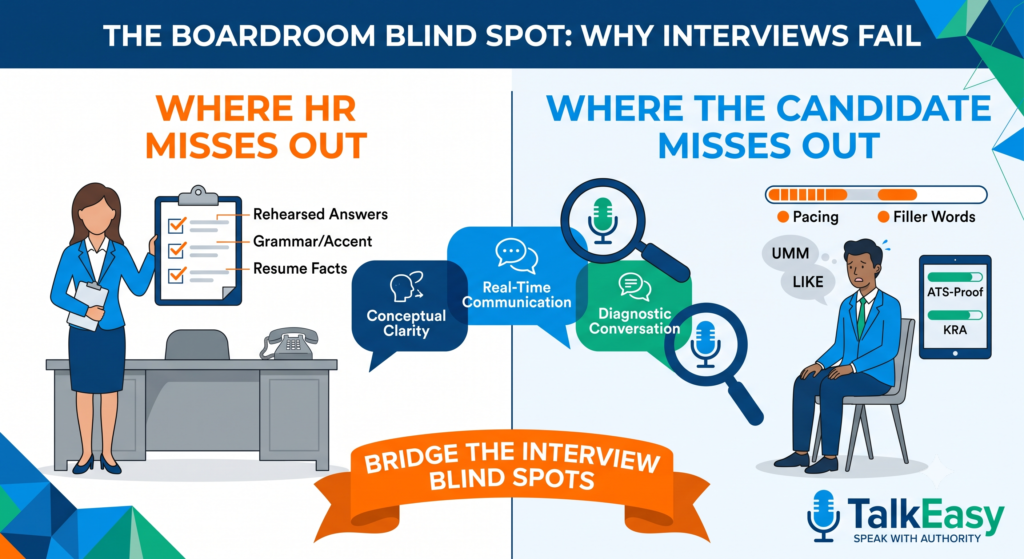
Something is getting lost in translation.
Drawing from nearly two decades of recruitment insights at TalkEasy, one truth becomes clear: traditional interview formats often fail both the interviewer and the interviewee.
                     TRADITIONAL vs. MODERN INTERVIEWING

  HR Focus:    Surface Resume Facts    ──>   Real Communication & Problem-Solving
  Candidate:   Rehearsed Answers       ──>   Authentic Capability & Soft Skills
  Result:      Transactional Hires     ──>   Long-term Cultural & Tactical Alignment
Part 1: What HR is Missing (The Recruiter’s Blind Spot)
1. Testing Memorization Over Real-Time Communication
Many interviewers rely heavily on standard, predictable questions (“What is your biggest weakness?”). Candidates respond with rehearsed scripts. HR misses out on testing how the candidate actually thinks on their feet, handles unexpected challenges, or communicates under pressure.
2. Over-Indexing on Accent or Grammar vs. Conceptual Clarity
Non-native speakers frequently get misjudged due to minor grammatical slips or accents, even when their core technical expertise and problem-solving skills are top-tier. By conflating flawless grammar with effective communication, HR rejects strong talent that simply needs minor polish in professional phrasing.
3. Neglecting “Candidate Experience” as a Two-Way Street
An interview isn’t just a test—it’s an interrogation vs. a partnership assessment. When HR spends 90% of the time grilling candidates without giving them room to explore team culture, KRA expectations, or real day-to-day dynamics, high-caliber talent walks away.
Part 2: What Candidates Are Missing Out On (The Job Seeker’s Blind Spot)
1. Failing to Decode Recruiter Jargon & HR Metrics
Candidates often enter interviews without understanding how HR evaluates them. Terminology like KRA (Key Result Areas), CTC breakdown, and ATS optimization aren’t just HR buzzwords—they are the benchmark metrics HR uses to justify a hire. When candidates can’t align their past achievements with these metrics, their value gets lost.
2. Ignoring Tone, Pacing, and Filler Words
Many candidates believe having the right experience is enough. However, recording mock interviews frequently reveals hidden blind spots: reliance on filler words (“um,” “like,” “you know”), rushing through explanations, or failing to structure answers clearly using framework models (like the STAR method).
3. Not Treating the Interview as a Consultation
Candidates often adopt a passive, “please hire me” mindset instead of acting as a problem-solver. HR wants to know how you will make their team’s life easier from Day 1.
How to Bridge the Gap
“An interview shouldn’t be an interrogation. It should be a diagnostic conversation where both sides determine if they can solve problems together.”
- For HR & Hiring Teams: Shift from rigid question lists to conversational, scenario-based interviews. Evaluate clarity, structured thinking, and adaptability over memorized scripts.
- For Candidates: Practice real-time spoken communication. Review recorded practice sessions to spot pacing and clarity issues, build ATS-proof application materials, and master the language of HR metrics.
Master Your Next Interview with TalkEasy
Whether you are preparing for your first job or looking to step into a senior role, TalkEasy provides structured cheat sheets, masterclasses, and diagnostic mock interview tools to help you communicate with authority and confidence.