
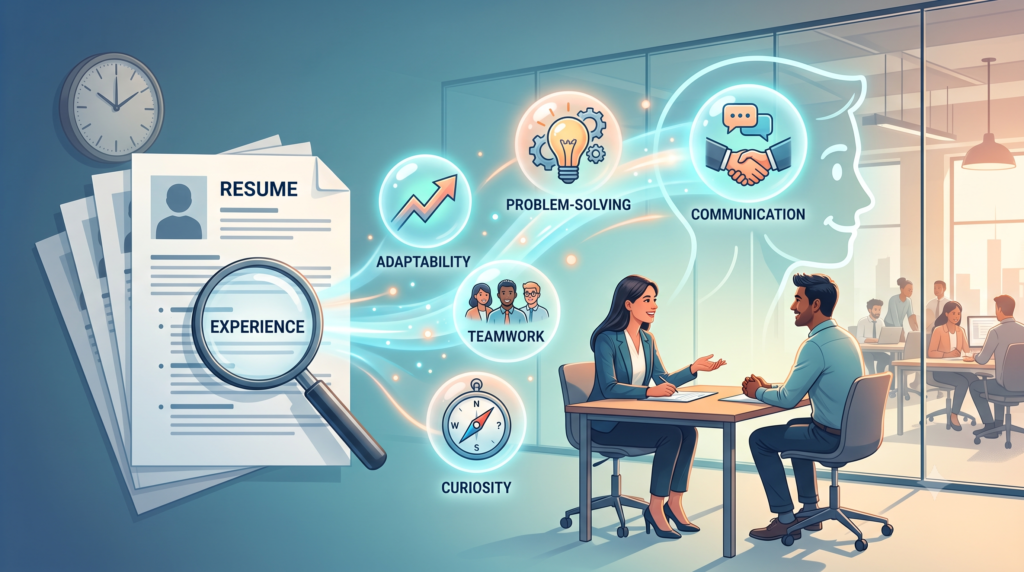
In traditional hiring processes, the resume reigned supreme. Candidates spent hours tweaking bullet points, aligning margins, and carpet-bombing applications with keywords designed to bypass Applicant Tracking Systems (ATS). For decades, a candidate with a prestigious university degree or a recognizable brand name on their CV automatically jumped to the top of the pile.
However, the modern workplace has shifted dramatically.
Rapid technological advancements, evolving workplace dynamics, and the rise of remote and hybrid setups mean that technical skills can become obsolete in a matter of months. Today’s top employers are realizing a fundamental truth: A stellar resume gets a candidate through the front door, but it doesn’t guarantee they will thrive on the team.
So, what are hiring managers and recruiters actually searching for when they look beyond the paper?
If you want to build a high-performing team—or if you are a job seeker aiming to stand out in a noisy market—here is an insider look at the core traits, mindsets, and values that drive hiring decisions today.
1. Curiosity & Adaptability: The Age of the “Learn-It-All”
Satya Nadella, CEO of Microsoft, famously quoted that companies need to shift from a culture of “know-it-alls” to “learn-it-alls.”
In past decades, deep domain expertise was enough to sustain a 30-year career. Today, with generative AI, automation, and rapidly shifting market demands, specific toolsets become outdated almost overnight.
Why Curiosity Matters More Than Experience
- Adaptability under pressure: Curious employees do not panic when processes change; they explore new solutions eagerly.
- Self-directed learning: Instead of waiting for formal company training, curious individuals upskill proactively.
- Continuous innovation: Asking “Why do we do it this way?” leads to process improvements and creative breakthroughs.
How to Spot or Showcase It
During interviews, hiring managers aren’t just listening to past achievements. They look for how candidates handle unfamiliar situations. Candidates who candidly share times they failed, adapted, and learned on the fly always win over candidates who claim to have all the answers.
2. Problem-Solving vs. Problem-Finding
Every workplace has problems. Processes break, deadlines shift, and client expectations fall through. Identifying a problem is easy—anyone can point out that something isn’t working.
What hiring teams desperately hunt for are solution-oriented operators.
Traditional Candidate:  "The project was delayed because the software kept crashing."
Modern Standard Candidate: "When the software crashed, I benchmarked two alternative tools, presented a 1-page comparison to leadership, and migrated the project without missing our final launch date."
The Power of the Ownership Mindset
Top companies want employees who adopt an ownership mindset. This means taking personal accountability for the outcome, rather than simply checking tasks off a list.
When you demonstrate that you see challenges as opportunities to build better systems, you position yourself as a proactive partner rather than just another employee.
3. Communication: The Great Force Multiplier
You can hire the brightest engineer, the most creative designer, or the sharpest data analyst, but if they cannot communicate effectively with cross-functional teams, their impact is severely capped.
Clear communication is no longer a “soft skill”—it is a business-critical requirement, particularly in remote and asynchronous work environments.
The Key Dimensions of Effective Workplace Communication
- Brevity and Clarity: The ability to distill complex, technical information into simple, actionable insights for non-technical stakeholders.
- Active Listening: Seeking to understand team dynamics and client needs before jumping in with a solution.
- Empathy and Emotional Intelligence (EQ): Navigating tough conversations, managing workplace conflicts constructively, and supporting teammates during high-stress periods.
Key Takeaway: Brilliance in isolation is a bottleneck. High emotional intelligence (EQ) paired with solid communication turns individual potential into organizational performance.
4. “Culture Add” Over “Culture Fit”
For years, human resources departments pushed the concept of “Culture Fit.” Unfortunately, this often led to corporate monocultures—hiring people who looked, thought, and acted exactly like the existing team.
Modern, forward-thinking organizations have replaced this outdated metric with “Culture Add.”
| Culture Fit (Outdated) | Culture Add (Modern Standard) |
| Focuses on similarity and comfort | Focuses on diversity of thought and experience |
| Asks: “Would I like to get a drink with this person?” | Asks: “What unique perspective does this person bring?” |
| Creates echo chambers and blind spots | Enhances innovation and problem-solving |
| Preserves the status quo | Drives company growth and evolution |
When evaluating culture, great companies look for alignment in core values (e.g., integrity, transparency, accountability) while actively seeking diversity in background, perspective, and problem-solving styles.
5. Resilience and Grace Under Fire
Resumes show victory laps. They list promotions, key metrics hit, revenue generated, and awards won. But success stories rarely reveal how a candidate reacts when everything goes wrong.
Workplace resilience isn’t about working 80-hour weeks without burning out; it’s about emotional stability and composure in the face of ambiguity.
Questions Hiring Managers Ask Behind Closed Doors:
- How does this person handle constructive feedback? Do they get defensive, or do they listen and pivot?
- What happens when a high-stakes project gets canceled at the last minute?
- Can they maintain high standards of quality under tight deadlines?
Candidates who can discuss past mistakes openly, share the hard lessons learned, and demonstrate resilience immediately establish trust with interviewers.
How to Apply This Framework
For Hiring Managers & Recruiters:
- Rethink Your Job Descriptions: Strip away unnecessary requirements (e.g., mandatory 8+ years of experience for mid-level tools) and focus on outcome-driven expectations.
- Use Behavioral Interview Questions: Ditch hypothetical scenarios. Ask candidates to describe specific past experiences: “Tell me about a time you had to pivot quickly when a project failed.”
- Evaluate Soft Skills Systematically: Score candidates on communication, adaptability, and culture-add metrics alongside technical skill assessments.
For Job Seekers:
- Tell Stories, Don’t Just List Duties: Use your resume and interviews to tell concise stories of problem-solving, growth, and team impact.
- Showcase Your Mindset: Don’t hesitate to highlight side projects, self-taught skills, or times you stepped up outside your explicit job scope.
- Ask Thoughtful Questions: An interview is a two-way street. Asking insightful questions about company culture, team dynamics, and learning opportunities proves your drive and curiosity.
Final Thoughts
At the end of the day, hard skills can be taught through onboarding, bootcamps, and day-to-day mentoring. Mindset, integrity, curiosity, and drive cannot.
As work environments continue to evolve, the most successful organizations will be those that look past polished resumes to hire whole, adaptable human beings. Whether you are building a team or taking the next step in your career, focusing on these underlying qualities is the ultimate competitive advantage.
Looking for your next career move or ready to join a team that values real impact over keyword-stuffed resumes? Explore our open positions on our careers page or drop a comment below to start a conversation!